
Virtual Advisory Boards: “Stakeholders on Tap”
How long will it be before someone automates stakeholder engagement?


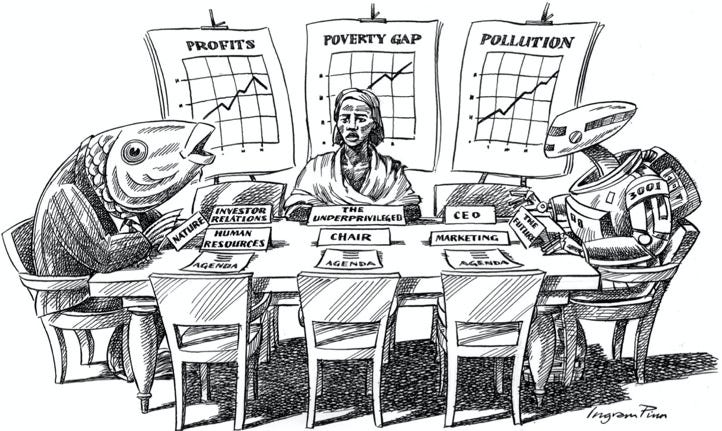
An icon of my professional work since 1991 has been the cartoon I got Ingram Pinn to do for me, showing a boardroom table with a fish in a business suit, a woman from the Global South and a robot seated. In case you haven’t seen it, I will drop it in at the end of this post. And the question in my mind now is whether the robot is getting ready to take over the entire process.
Whatever I thought back then about what I might be doing with the rest of my life, I have now spent decades operating on the ragged frontiers of stakeholder capitalism—campaigning, consulting, and serving on more than 80 boards and advisory boards, a dozen of them still active at any given time. Indeed, I have just joined one for Imperial Business School’s Leonardo Centre on Business for Society.
That experience, colliding with my growing interest in—and exposure—to AI, has left me wondering:
Now that virtual advisory boards look like a foregone conclusion, will they advance the positive, systemic change we need, or not?
Someone I caught up with during WBCSD’s London Climate Action Week (LCAW) event, of which more in a moment, was José Luis Blasquez, Acciona’s global sustainability director. I reminded him that he had raised the possibility of a virtual advisory board some time back when talking with our CEO, Louise Kjellerup Roper. And now we are toying with the idea of making it a reality.
First as a minimum viable product; then, if it gains traction, as a minimum viable system for better informing key decisions worldwide.
Banksy at London Climate Action Week
So how appropriate that my first LCAW event of was hosted in the Institute of Directors, from which I resigned years ago (having contributed a regular column for their Director magazine) because of their intransigence on sustainability issues. Now the window of the IoD room in which Mondiale Impact were hosting their breakfast event on tomorrow’s governance agenda directly overlooked my current favorite Banksy artwork.
A besuited figure strides off a plinth, entirely blinded by a large, billowing flag.
In the background, in contrast, a gilded statue of Athena adorns the façade of the Athenaeum Club—where Max Nicholson, David Layton and I co-evolved what would later become Environmental Data Services (publishers of the ENDS Report), almost fifty years ago. Athena symbolizes wisdom, but I sometimes wonder whether the flag-smothered Banksy isn’t a better representation of where our species currently finds itself on climate action?

From barometers to advisory boards
In retrospect, three LCAW events helped nudge this thought process into overdrive. The first was the Mondiale Impact session, followed later the same day by WBCSD’s launch of their 2026 Business Breakthrough Barometer, and then, third, the following day, a Google-hosted session on the climate-related applications of the company’s technology: AI for the Planet.
Billed as the largest edition yet, WBCSD’s 2026 Business Breakthrough Barometer draws on the views of more than 500 senior leaders across 50 economies and companies, in total representing over US$2 trillion in revenue.
Read side by side, the two events, hosted by Mondiale Impact and WBCSD, sketch a supply-and-demand curve. The Barometer turns out to be the demand side—proof that the need for sound sustainability judgment is climbing fast and getting harder to satisfy.
And third, I took part in a Google-hosted “AI for the Planet” event which offered a glimpse of the emerging supply side—with new forms of intelligence virtually on tap, available in the moment where you need it.
And sitting somewhere between all three is an institution most people never think about until they need it: the advisory board. What might happen if someone managed to put stakeholders on tap by creating tuneable virtual advisory boards?
The demand side: judgment getting harder
For decades, as I have argued elsewhere, so-called “corporate sustainability” was mostly soft—a matter of ambition, reputation, and voluntary pledges. Intentionally or not, the latest edition of WBCSD’s Barometer captures the moment that era ends. Now, as WBCSD CEO Peter Bakker put it, the phase driven by ambition is giving way to a more durable one, in which sustainability increasingly pays its own way “as a source of resilience and competitiveness.”
WBCSD’s numbers were striking. Ninety-two percent of leaders now expect sustainability to deliver competitive advantage over the next five to ten years, and 89% maintained or increased their investment last year. This is no longer the language of corporate social responsibility; instead, it is the language of capital allocation.
But confidence comes with anxiety. Sixty-eight percent think a disorderly transition—unplanned, poorly coordinated, expensive—is more likely than a year ago, and 40% rate it a significant risk. Just 15% feel fully prepared. Nearly half report that physical climate impacts pushed costs up last year through supply-chain disruption, commodity volatility, and rising insurance bills. And 85% would rather see policy strengthened than delayed, with policy clarity now cited by more than half as decisive in where they invest.
Strip away the percentages and the message comes through loud and clear. Tomorrow’s decisions will be bigger, more contested, and more publicly scrutinized than ever. Meanwhile, those charged with making them are not at all sure that they have the judgment to get them right.
Harder decisions need better advice, so the appetite for credible, independent counsel is likely to grow, not shrink.
Enter AI
This is exactly the appetite Google’s “AI for the Planet” event aimed to feed. The implicit, unstated message I took away was this. Synthesis across climate science, ecology, economics, law, and supply-chain engineering, will increasingly be available at a speed and breadth no human mind or panel can match. And it will be delivered continuously rather than quarterly, and—in principle—it will be available to anyone with a connection, not just those who can afford a stellar boardroom.
If the Barometer shows a world starved of judgment, the obvious answer is to produce more of it. That is the basic promise of the virtual advisory board: a standing panel of synthesized expertise, on call, on demand, on tap. At a time when most advisory boards operate in corporate silos, their thinking confined by host organizations and non-disclosure agreements, how might AI’s ability to aggregate and synthesize help?
What an advisory board is for
Experience suggests the hardest part of advice was never the availability of information. An advisory board is not valuable because of what any single member knows. It is valuable because of what well-moderated external perspectives, held in combination, produce together—a quality of judgment no individual possesses alone.
A good board does at least six things at once. It supplies knowledge. It confers legitimacy—telling the world that serious, independent people have looked hard at the question. It provides independent challenge—the willingness to tell a chief executive, to their face, that they are wrong. It carries accountability, with named individuals staking their reputations. It convenes wider networks. And, in sustainability above all, it offers representation—of stakeholders, affected communities, and disciplines that would otherwise have no seat.
The magic is in the combination. It is in the friction between a climate scientist, an indigenous-rights advocate, a supply-chain economist, and a sceptical investor—arguing in the same room—that produces advice worth having. Disagreements are not a bug to be smoothed away; they are a critical part of the value.
But this is where trouble starts. A large language model is, at its core, a machine for smoothing away disagreements. Ask it to synthesize ten perspectives and it hands you a confident, plausible consensus—the very thing a real board exists to resist.
The case for: better counsel, more widely shared
The upsides are likely to be real and demonstrable. Continuous availability beats quarterly meetings: a board that meets four times a year cannot help with the decision you face next Tuesday; a virtual one can.
Interdisciplinary synthesis that no living human holds in a single head becomes available. The reasoning can be made traceable and reproducible in a way the consensus of a human committee rarely is. Certain failure modes—deference to the powerful, groupthink, the conflicts of paid directorships—can also, at least in principle, be designed out.
Then there is access. The transition will be won or lost as much in emerging economies as in the boardrooms of the Global North, yet a world-class human board remains the preserve of the wealthy and well-connected. A credible virtual one—cheap, multilingual, always on—could put heavyweight counsel within reach of a mid-sized manufacturer in Lagos or a cooperative in Jakarta. That may be the single most important argument in the whole debate.
The honest framing is a spectrum, not a switch. “Augment” and “replace” are two ends of a dial, and most of the really useful territory lies between—with AI preparing the ground for a human board, stress-testing its assumptions, and widening the voices it can consult and communicate with.
The case against: laundered legitimacy
Turn the dial too far and the risks compound. The sharpest is legitimacy-laundering. A board’s blessing is social proof, and social proof is what greenwashing needs. “Our AI advisory board validated this strategy” is a sentence designed to end arguments rather than start them.
Then there is representation. A model trained on the internet over-represents the already heard and under-represents exactly those a sustainability board most needs: frontline communities, indigenous knowledge holders, the global poor. Stakeholders on tap are very likely stakeholders you can influence or even control.
Deeper still is the problem of values. Sustainability is not fundamentally a knowledge problem; it is one of contested, intergenerational ethics—whose interests count, over what horizon, against whose costs. A system can model a value without holding it, describing what an indigenous community would say without bearing the consequences of saying it.
A system fine-tuned to be helpful, deployed by the people it is meant to scrutinize, may never quite find the nerve.
The principles we need now—not later
So, virtualization risks automating the cheap part of a board—the knowledge—while hollowing out the expensive part: independent, accountable, representative judgment. This is mission-critical because first-generation design choices harden into defaults. The conventions set for the earliest virtual advisory boards will shape the field for years afterward. And principles cannot be retrofitted onto a practice that has already congealed.
Three elements seem essential.
Ethics: independence from the commissioning party, so the advisor never quietly serves the advised; transparency, always, about what is human and what is machine; and outputs designed to invite challenge, not foreclose it.
Accountability: a named human on the hook, with real liability, and a standing duty to challenge so “no” remains possible.
Design: treat augment-versus-replace as a declared point on a spectrum, not a fudge; build in representation deliberately rather than hoping the training data supplies it; and make the provenance of every piece of advice auditable after the fact.
Often, getting the right people in the room is the easy part. The harder, more valuable dynamics concern whether the board generates real friction or a smooth, agreeable blend. Some dials I’d want on the control panel:
Cognitive, not just demographic, diversity—how members think, not only who they are.
Challenge intensity—set high, ideally with a dedicated devil’s advocate.
From incremental to systemic—who can help you co-evolve a minimum viable system for next-generation challenges?
Time horizon—inject a “voice of 2050,” even of those not yet born, to disrupt present bias.
Dissent over consensus—surface and keep minority reports rather than resolving them to tidy answers.
Anti-capture independence—the right to say “you’re asking the wrong question,” because the worst failure is a fluent answer to a self-serving one.
The absent and the adversarial—include the future regulator, the litigator, the hostile NGO, the voiceless ecosystem.
Memory and accountability—does the board recall what it advised and hold the business to account next time?
Then the sting: every dial turns both ways. The same freedom to tune up challenge and dissent lets you quietly tune them down. So, the real question isn’t what we’d tune a board for. It’s who gets to see and set the dials.
Coda: A Ladder of Virtualization
The WBCSD Barometer demonstrates that the demand is real, the stakes hardening. And Google’s LCAW event showed relevant capabilities arriving fast, ready or not. The question for the 2030s isn’t whether advisory boards get virtualized—that’s already under way—but whether the first generation is built deliberately, with legitimacy, challenge, representation, and accountability built in, or bolted on afterwards in the wreckage of the first scandals.
So, are stakeholders to be put on tap—summoned, synthesized, dispensed on demand to serve whoever turns the handle? Or will some remain at the table—present, awkward, occasionally furious, able to disrupt the very people who invited them? The technology can deliver either. Which one we get is, for now, still up to us.
The final question, at least here: what might the spectrum of possible formats look like? Here’s a first stab: a 6-stage model, with growing AI-driven autonomy from left to right.
Now let’s climb the ladder:
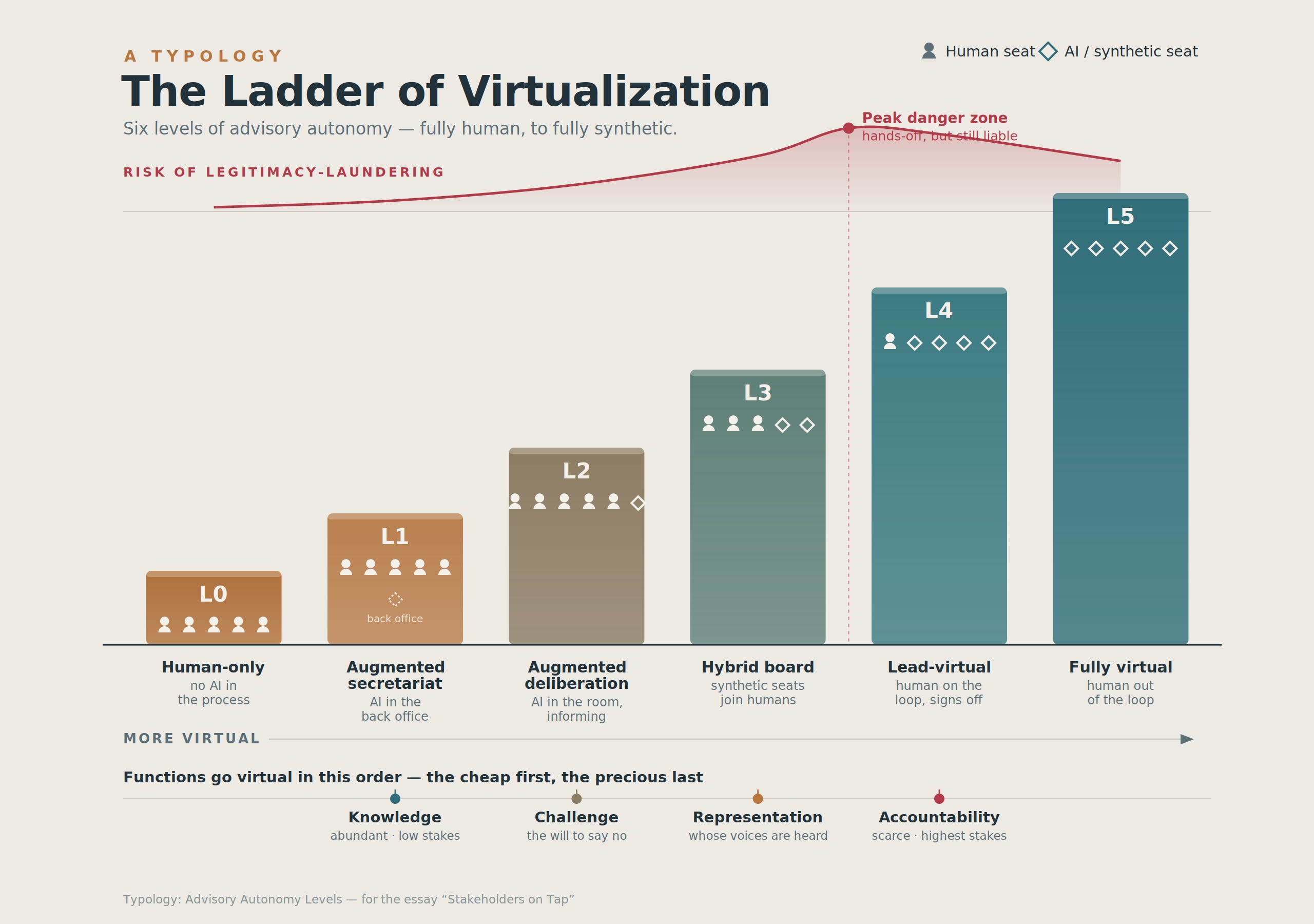
Level 0—Human-only. The traditional board: humans deliberate, decide, and sign off, with no AI in the process. The baseline, and for some high-stakes, values-laden questions still the right setting rather than a primitive one.
Level 1—Augmented secretariat (AI in the back office). AI prepares briefing packs, researches, summarizes, drafts minutes. Deliberation remains wholly human. Knowledge is virtualized; everything else stays human.
Level 2—Augmented deliberation (AI in the room). AI joins live—factchecking in real time, modelling scenarios, surfacing blind spots, playing the data-on-tap thirteenth member. It informs but doesn’t vote. Humans still own the judgment. This is where most serious boards will sit by the late 2020s.
Level 3—Hybrid board (synthetic seats). Some “members” are now AI personas representing voices a real board can’t easily seat—future generations, an ecosystem, an absent market, a hostile regulator—deliberating alongside humans who chair and retain override. The representation function starts to virtualize.
Level 4—Lead-virtual (human on the loop). The synthetic panel does the bulk of the deliberating and produces recommendations; a human supervises, can intervene, and signs off, but is now the exception-handler rather than the driver. Challenge and judgment are largely virtualized. The accountability of the supervising human is real on paper but thinning in practice.
Level 5—Fully virtual (human out of the loop). An autonomous, continuous synthetic board issuing advice with no human in the routine loop. Maximum reach, lowest cost, widest access—and the point at which named, accountable judgment disappears entirely unless it’s deliberately re-engineered back in.
So, what do you make of all this? And how do you see the next steps? An inquiry into emerging best practice? A standard-setting forum? A minimum viable product prototype? All are going to happen—so who is interested in pushing which options forward?
The line is open.
Really thought-provoking. Thank you.
Thank you for sharing John - brilliant insights here, lots of food for thought! I do fear L4 and L5 are contingent on the LLM being able to hold and maintain a divergent view, even in the face of challenge - I’ve not seen much evidence of AI achieving this (yet) and welcome any examples. My experience of it has been mostly sycophancy - even very well-disguised sycophancy where on the surface it may seem like it’s disagreeing. I would really like to follow your and Louise’s experiments with this, and wondering also how we might think to implement this on our own advisory board.