
Here Comes Quantum Sustainability
In the final part this 3-part series, I explore an idea that is buzzing around my head


“Sustainability is dead!” some people intone. No, I say—some parts of the movement are in freefall, true, but some in remission and others in rude good health. Meanwhile, the parts most likely to survive are mutating fast.
As I’ve worked to make sense of tomorrow’s sustainability agenda, I have kept finding my brain hijacked by the strange, counterintuitive world of quantum science. I am not arguing that quantum physics holds ready-made answers to the world’s environmental and social crises, but I know that quantum thinking is helping me to reimagine sustainability.
Not that this is a novel investigation. When I mentioned this emerging focus in the first of this 3-part series, a former colleague—Duncan Pollard—noted that he had posted a blog talking about quantum sustainability back in 2018. And if you search the internet you quickly surface other thinking on the theme, though it’s mainly about how quantum technologies can help deliver sustainability.
My take is linked, but different. The question I am asking is how we might use quantum metaphors as a way of better understanding, addressing and communicating—the sustainability challenge.
It has often struck me that many advocates see sustainability as an inherently conservative project—about protecting what we have, minimizing damage, and preserving the status quo for future generations. Nothing wrong with that, but I’ve long seen it differently.
To me, sustainability is about disruption, redesign, and ultimately transformation. And that line of thought has led me inexorably toward the notion of quantum sustainability.
Next stage in triple bottom line thinking?
“Quantum sustainability” is not (yet) a formal scientific discipline, complete with research councils and endowed chairs. For now, it is better understood as an emerging conceptual lens—one that draws on insights from quantum science, particularly ideas of entanglement, superposition, uncertainty, and the “observer effect,” to rethink how we understand, govern, and invest in sustainability solutions.
At its core—as I see it—quantum sustainability starts from a simple proposition: today’s environmental, social, and economic challenges cannot be solved using linear, reductionist thinking. The world is too interconnected, too uncertain, and too reflexive for that.
Instead, sustainability demands approaches that acknowledge deep interdependence, embrace uncertainty, and recognize that outcomes must be co-created through action and observation.
From this perspective, sustainability becomes:
Entangled, with ecological, social, economic, and technological systems inseparable.
Non-linear, so small actions can trigger disproportionate shifts.
Probabilistic, meaning that the future cannot be predicted, only navigated.
Reflexive, suggesting that our measurements, governance systems, and narratives actively shape outcomes.
This reframing matters because it changes not only what we see as our responsibility but, more fundamentally, also what we see as possible.
Beyond systems thinking
You might reasonably ask: how is this different from systems thinking? To my mind, the two are closely related, but quantum sustainability pushes the logic further.
Where systems thinking emphasizes interconnected systems, quantum sustainability insists on inseparability. In an entangled world, there is no meaningful “outside” from which to intervene. We are already part of the systems we seek to manage.
Where systems thinking relies heavily on feedback loops, quantum sustainability foregrounds the observer effect—the idea that the very act of measuring a system can sometimes change its behavior. In sustainability terms, this means recognizing that the metrics we design, the data we collect, and the disclosures we require do not simply describe reality; directly or indirectly, they may actively shape it.
Where scenario planning treats uncertainty as something to be managed on the margins, quantum sustainability accepts probability and uncertainty as permanent conditions. The goal shifts from prediction to preparedness, from optimization to resilience and, potentially, regeneration.
Where much of today’s sustainability practice still pushes organizations and markets toward efficiency, quantum sustainability recognizes that the systems we operate within pursue multiple, sometimes competing objectives, simultaneously. In this world, success lies not in maximizing any single variable, but in learning how to “stack” and balance resilience and value across layers.

Tracing the roots
There are many ways of slicing this pie, but the intellectual roots of quantum sustainability reach back at least to 20th-century quantum science, and are associated with figures such as Niels Bohr, Werner Heisenberg, and Erwin Schrödinger.
None of them, to my knowledge, wrote much about sustainability. But their work fundamentally altered how we understand reality, causality, and observation—and in doing so, undermined the assumptions of linear control that still dominate so much of today’s policy and management thinking.
From the late 20th century onward, scholars began applying non-linear ideas to living and social systems. Thinkers such as Fritjof Capra explicitly connected physics, life sciences, and sustainability, while Donella Meadows’ work on leverage points anticipated quantum ideas about intervention, feedback, and unintended consequences.
Later frameworks—focusing on planetary boundaries (led by Johan Rockström), socio-ecological systems thinking (think of Otto Sharmer’s Theory U) and Doughnut Economics (championed by Kate Raworth)—pushed sustainability beyond incremental improvement toward whole-system stewardship.
More recently still, scholars and practitioners in leadership, futures, and organizational theory have begun using quantum language to describe uncertainty in decision-making, distributed responsibility, and relational value creation. To date, this work appears under labels such as quantum leadership, quantum management, or post-linear sustainability, rather than as a single codified theory. Which makes it hard to bring into focus.
What quantum sustainability is—and isn’t
To be clear, my aim is not to offer a formula for solving the world’s wicked and super-wicked problems. That would be beyond hubris. But quantum sustainability offers—at least for now—a powerful new framing device, a way of orienting ourselves in a world that no longer behaves as our old models assumed and predicted.
Quantum sustainability does not just mean using quantum computers to solve sustainability challenges. Nor does it claim that ecosystems behave like subatomic particles. Instead, what it does offer is a metaphor, grounded in modern science, for thinking and leading under conditions of growing complexity, uncertainty, and—the bit that is truly hard to get our brains around—entanglement.
Used carefully, this approach can help us escape false trade-offs and design strategies and policies that work across systems and over time. Those false trade-offs were a key part of what led me to announce a “product recall” for the triple bottom line, back in 2018—with that thinking iterated further in 2020’s Green Swans and 2024’s Tickling Sharks.
So, what are we talking about here? Well, a working definition might run as follows:
Quantum sustainability is an approach to sustainability that treats ecological, social, and economic systems as entangled, non-linear, and shaped by human observation and intervention—requiring leadership focused on stewardship, adaptability, and multi-layer value creation rather than control and optimization.
Over time, this approach may well evolve into an interdisciplinary field combining quantum technologies with quantum-inspired systems thinking. The outcomes, if this does happen, will very much depend on who is involved—and how.
Four arenas of impact
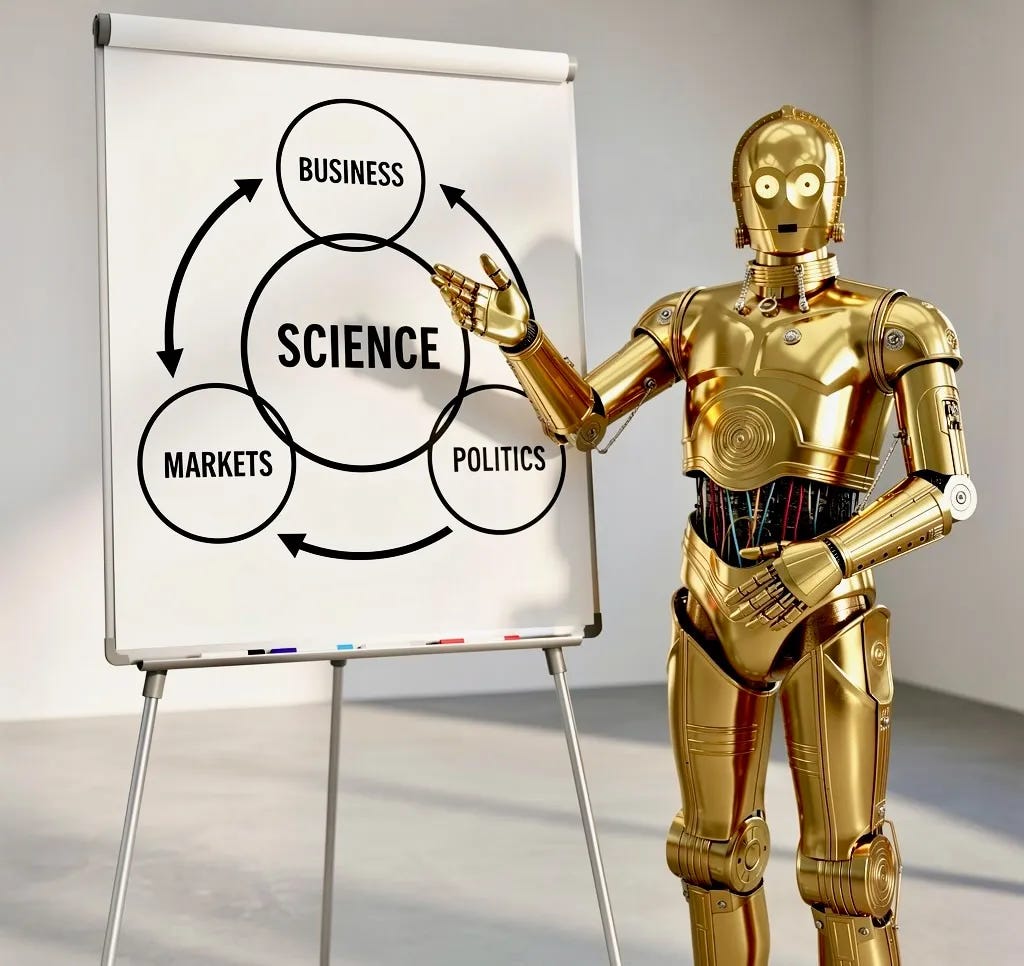
I’m particularly interested in how all of this might play out across four key domains that, for me, increasingly define the sustainability agenda: science, markets, business, and politics. What follows is not a solution map for the world, but a personal compass—one that helps me orient my own evolving work.
1. Science
Science is now under attack in some countries, but is central, foundational. Quantum sustainability has the potential to reshape it by changing not only what we study, but how we understand reality itself. It encourages a move beyond linear cause-and-effect models toward an appreciation of the entangled systems in which things like climate, materials, energy, cities, biology, and human behavior co-evolve.
By treating uncertainty and probability as features rather than flaws, quantum sustainability supports research agendas oriented toward robustness, adaptability, and learning, rather than misleading precision. At the technological frontier, quantum tools promise breakthroughs in materials, sensing, and optimization that could accelerate decarbonization and rewilding.
2. Markets
The whole point of this Rewilding Markets series has been to widen my own lens—from businesses (and their boards, brands, business models, and supply chains) to the markets they serve, and to how those markets themselves might be redesigned through time.
In economics, the master discipline of capitalism and wealth creation more generally, quantum sustainability challenges the deep-rooted fiction of isolated markets. Risk, inequality, and environmental impact are no longer externalities to be corrected after the fact, but entangled outcomes that are dynamically and continuously co-produced. Capital allocation, viewed through this lens, needs to reward robustness and system health alongside financial return.
By treating monitoring, measurement, disclosure, and pricing as active interventions rather than neutral observations, markets can be designed to steer human behavior toward long-term resilience rather than short-term extraction.
3. Business
For business, quantum sustainability shifts strategy beyond efficiency and scale toward systemic value creation. And that’s a big jump for people trained in today’s business schools. The basic idea here is that by embracing uncertainty rather than denying it, businesses can design adaptive models capable of succeeding across multiple possible futures.
Trade-off thinking gives way to stacked value creation—not just the sort of shared value that better distributes today’s wealth. Companies that have spotlighted their shared value commitments are taking the lead again, this time in throttling back.
I served for nine years on Nestle’s Creating Shared Value Council, which (I think) is where I first met Ducan Pollard—so I was intrigued to hear their current CEO, Philipp Navratil, blaming President Trump for muting the company’s voice on ESG and sustainability. “In all of the investor meetings I have done,” he told a Nestlé staff meeting last month (according to the Financial Times, 22 January), “nobody asks, not one has asked about sustainability.”
But, in very much the same way that things that go up don’t go up forever, things that go down often do not go down forever. Waves may rise, peak and recede, but more waves are on their way. Indeed, I covered my thinking on waves and cycles in this series of posts last July.
My sense is that we are seeing rearguard actions from those with vested interests in the old order, and with potentially strandable assets, to cling on to what was, as system change roars through. But new orders are evolving all around us—and some of them will ensure that things like climate action, innovation, risk reduction, and growth reinforce one another rather than competing.
If they out-compete the alternatives, we survive. And if they don’t, we don’t. Clearly, we are very long way from that happy state, witness the Trump Aberration, but it’s what we must now play for.
4. Politics
Fourth, and finally here, quantum sustainability offers a new lexicon—and a new grammar—for politics. At local, national, and global levels, it challenges the illusion that policy problems can be neatly contained within borders or electoral cycles, highlighting instead the entanglement of concerns like climate, security, health, economics, and social cohesion.
By embracing radical uncertainty, this approach supports governance processes and systems that prioritize resilience, adaptability, and learning rather than traditional ideas of control. Laws, metrics, and disclosures eventually become interventions that shape behavior across entire systems.
The leading edge of politics must expand from managing competing interests to coordinating responsibility across nations and generations. Not a vote-winner for right-wingers, perhaps, but there is a limit to how long any of us can defy gravity and the other forces of nature.
When will we win?
Quantum sustainability will only be taken for granted by the late 2030s if it stops being a slogan—an inevitable stage it still must pass through—and becomes part of our cultural infrastructure: in the form of standards, curricula, procurement rules, data systems, and career paths.
Its ultimate success and mainstreaming will depend less on sudden scientific breakthroughs than on a decade or more of institutional lock-in, as quantum tools and quantum-inspired systems thinking become normal parts of how we do science, price risk, run firms, and govern our societies and, ultimately, the wider world.
Want a glimpse of what that might look? Consider France’s new law on PFAS, better known as “forever chemicals.” As Le Monde put it:
The French law, approved by lawmakers in February [2025], bans the production, import or sale from January 2026 of any product for which an alternative to PFAS already exists. These include cosmetics and ski wax, as well as clothing containing the chemicals, except certain “essential” industrial textiles.
A ban on non-stick saucepans was removed from the draft law after intense lobbying from the owners of French manufacturer Tefal. It will also make French authorities regularly test drinking water for all kinds of PFAS.
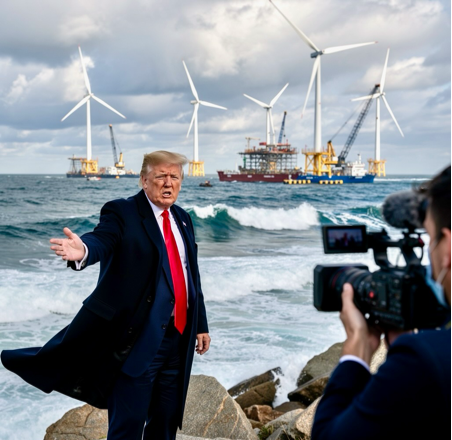
One swallow doesn’t make a summer, of course, but Trump and his fellow travelers sense which way the winds of change are blowing. (Perhaps that’s why he’s tilting so energetically at windpower projects?)
Eventually, quantum sustainability will become boring—given that boring is what “taken for granted” looks like. Boards will routinely ask about quantum sustainability exposure and opportunities, much as they now ask about cyber and AI risk. And business schools will teach quantum sustainability literacy in much the same way that they are beginning to teach AI literacy: not to train physicists, but to prepare tomorrow’s decision-makers.
Yes, this is a field that taxes the brains even of most scientists involved, but it’s a very long way from being boring. And, as this series of posts indicates, it is where my compass and brain are now pointing. The emerging course, I’m glad to say, is becoming a little clearer in the process—even if the final destinations and outcomes remain distinctly hazy .
As ever, any comments or suggestions would be very welcome.
There is a lot to consider with quantum physics with a closer connection to life, living systems and holism rather than planet first and people second as has been the case in sustainability for too long. Thank you. Is n’t this what regenerative economics is taking on?
Thanks, John, this is very helpful, not least because you're integrating a lot of diverse ideas into a tighter aperture - and bringing them into an investigation space that deserves further observation, (or not, as it may be).
The idea of non-linear sustainability does feel increasingly relevant. System complexity appears to be moving faster than folks at the face of sustainable change can adequately process, let alone respond to.
Given the high level of demand you and GlobeScan identified for more radical agenda change (I'm comfortably among that 56%), this kind of work seems crucial - not as an end goal, but as a discipline for making better sense of transformative change. (I also liked Nicola's point about it being 'a practice-tested body of complexity science').
I've been exploring something in parallel through the lens of 'alchemy' - not as an entire end state, but as a way of naming an adaptive process for making sense of, and bringing about change that currently seems impossible.
Like you, I'm wary of this drifting into abstract mysticism or rejecting science. If it has value, it should be applied across science, markets, politics - while also pointing to the inner, relational and cultural shifts that technical solutions alone seem unable to carry.
Alchemy is by no means a perfect word - perhaps usefully so. It's interesting that it appears, in different forms, across both Eastern and Western traditions.
Either way, feels like we're scratching the surface.
I tried to explore this from a slightly different angle earlier this month, in case it's of interest:
https://open.substack.com/pub/theboyinthewildwood/p/a-meeting-by-the-river?utm_campaign=post-expanded-share&utm_medium=web