
Finding Our Way
What Pacific Wayfinders — and the Chelsea Flower Show — Can Teach Our GPS-Dependent World

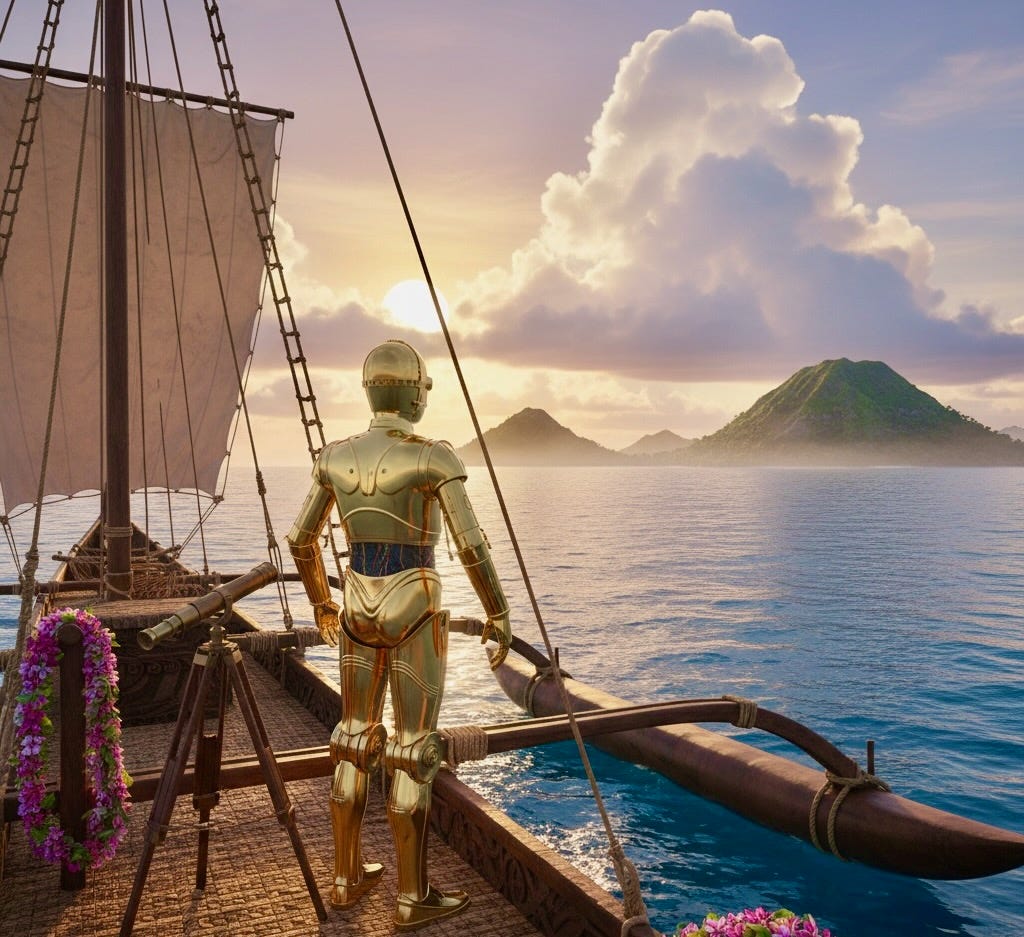
Somewhere off the coast of Hawai’i, a woman stands on the deck of a double-hulled canoe, reading the sky. There is no chart in her hands and no screen lit blue against her face. She is tracking the rise and set of stars across thirty-two “houses” of the Hawaiian star compass; feeling the pulse of long-period swells against the hull; watching for the noio, the black noddy tern that flies out to sea at dawn and returns to land at dusk.
Her name is Lehua Kamalu, and she is the first woman to captain and navigate Hōkūleʻa, the voyaging canoe that for fifty years has been quietly reigniting one of the most extraordinary skills humans ever developed.
The BBC called her tradition the work of “Polynesia’s master voyagers who navigate by nature.” That phrase is doing a lot of polite lifting. What it really describes is a body of knowledge, accumulated over three thousand years, that allowed Pacific peoples to find pinpricks of land in ten million square miles of open ocean — and to do so reliably, repeatedly, in both directions.
Hawai’i to Tahiti and back. Tahiti to Aotearoa. Up to Rapa Nui, that loneliest of inhabited specks. No sextant. No compass. No clock. Just the stars, the swells, the birds, the clouds, the color of the water and a mental model of the world held entirely in the head of the navigator and passed, in chant and apprenticeship, from one generation to the next.
It is, as the historian Christina Thompson has argued, plausibly the greatest migration story in human history. Greater than the Atlantic crossings. Greater than the silk roads. People who walked out onto the open sea, reading it the way the rest of us read a familiar street.
What colonization did to a way of knowing
That skill nearly died out. Not because it stopped working — it always worked — but because the people who held it were colonized, converted, schooled and in some cases outlawed. By the mid-twentieth century the great voyaging canoes were gone, the chants half-forgotten, the master navigators reduced to a handful of elderly men in Micronesia.
The condescending Western myth, popularised by my childhood hero Thor Heyerdahl and his Kon-Tiki expedition, was that Polynesians could not really have navigated these distances on purpose. They must have drifted. Stumbled. Been blown.
This was a lie, but it was a useful lie. It allowed the imperial project to dismiss Pacific peoples as passive recipients of geography rather than its most skilful readers. It allowed schools in Hawai’i to ban the Hawaiian language well into the twentieth century. It allowed a whole epistemology — wave-reading, star-reading, bird-reading — to be reclassified as folklore.
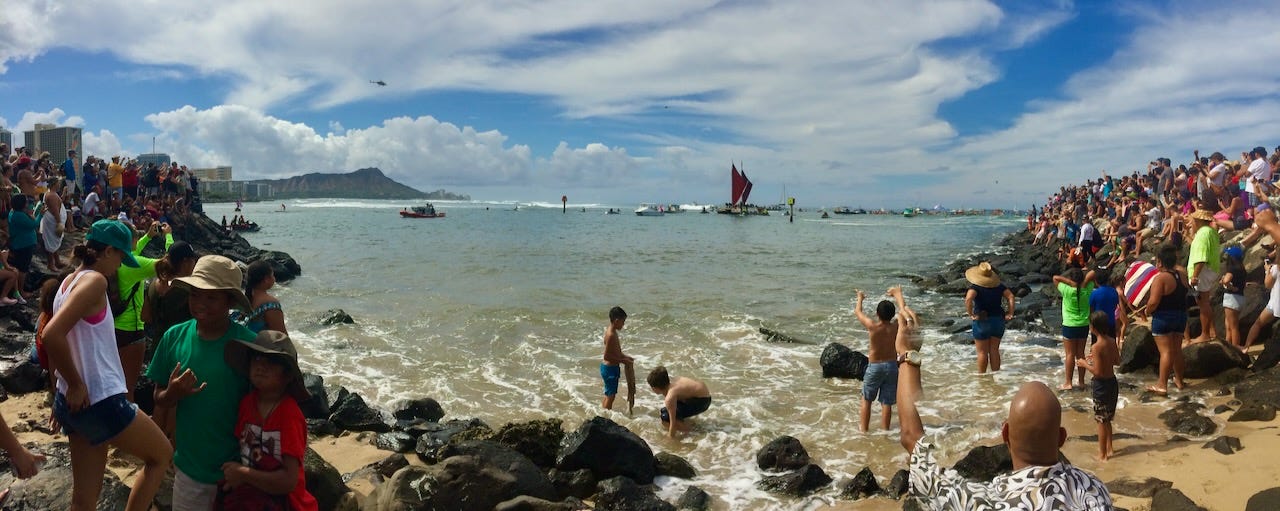
The revival began in 1976, when the Polynesian Voyaging Society built Hōkūleʻa and persuaded the Micronesian master navigator Mau Piailug to sail her from Hawai’i to Tahiti using nothing but traditional methods. The voyage succeeded. It was not folklore. Mau then did something his own tradition had forbidden: he taught outsiders.
He trained Nainoa Thompson, who in 1980 became the first Native Hawaiian in roughly six centuries to navigate that route without instruments. Thompson in turn has trained a generation, and that generation has — quietly, and against the grain of an older patriarchy — admitted women. Kamalu and her colleague Kaʻiulani Murphy are expected to be among the first women in known history to be granted pwo, the rank of master navigator.
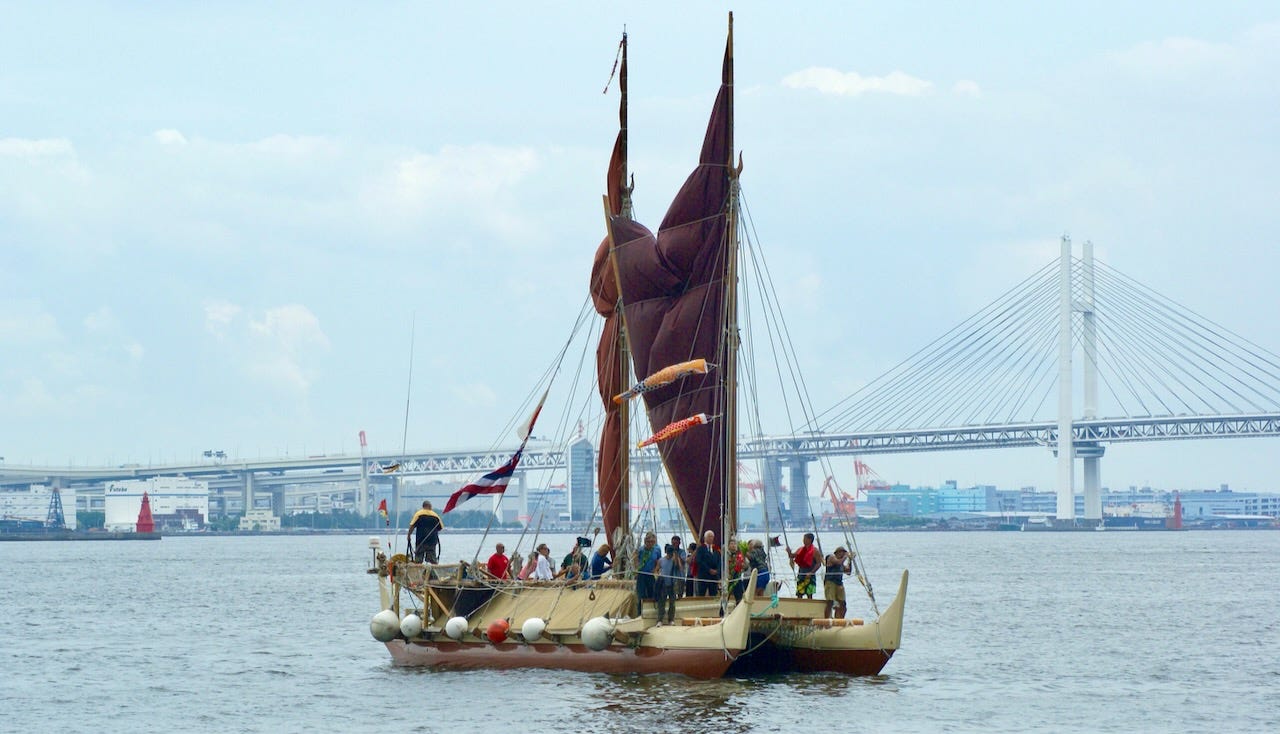
The recovery is not a museum exercise. Hōkūleʻa has now circumnavigated the globe. Her voyages are watched in classrooms across the Pacific. Kamalu speaks of wayfinding as an act of “forgetting the modern world” — a discipline of attention so total that GPS feels not just unnecessary but actively in the way.
The little blue dot
Which brings me to a book I bought yesterday. Katherine Dunn’s Little Blue Dot: How the Global Positioning System Shaped the Modern World is, on the face of it, a history of a satellite network. It is really a history of what happened when we outsourced our location to machines.
Dunn’s argument, simply told, is that GPS — born in the Cold War, weaned on the Vietnam bombing campaigns, refined for cruise missiles and then quietly handed to civilians — has done something more profound than help us find restaurants. It has rewired the relationship between human beings and place.
It runs our farms, our supply chains, our power grids, our stock exchanges, our stop lights. It is the invisible scaffolding of modern life. And it has, in Dunn’s phrase, taken away our familiarity with getting lost. That sounds harmless. It is not.
When you cannot get lost, you also cannot find your own way. The faculty atrophies. London cab drivers, famously, grow the part of their brain that handles spatial memory by passing the Knowledge; the rest of us, following the chirpy voice of a phone, are doing the inverse exercise.
We have offshored navigation to twenty-four satellites the average user could not name, and we collectively would struggle to replace. The system is, Dunn shows, extraordinarily vulnerable — to jamming, spoofing, solar weather, geopolitical sabotage. The little blue dot on your screen is held in place by a thread.
The contrast with Kamalu standing on her deck is almost embarrassing. One tradition holds the map of the Pacific in a human mind, recoverable, teachable, redundant by design. The other holds the map of everywhere in a constellation of metal boxes 20,000 kilometres up, owned by a single government, and assumes the signal will keep arriving.
Deep time and skills we lose along the way
What the Hawaiian revival recovers is what we might call a deep time skill: a competence developed over thousands of years, refined by people whose survival depended on its accuracy, and capable of operating without any infrastructure beyond a clear sky and a trained body. Such skills are not nostalgia. They are insurance. They are also, quietly, a different theory of what a human being is for.
We are living through our own disrupted passage now — through gathering climate chaos, through tsunamis of misinformation and scams, through the disassembly of a postwar order that most of us assumed was permanent.
It is worth asking who, in previous storms, knew how to read the sky.
I think of Sir Winston Churchill in 1940, refusing the available wisdom that a deal with Hitler was the only rational option, and instead navigating by older stars: a conviction about civilisation, a feel for the long arc of British constitutional life, a refusal to accept that the route ahead was the one the present winds suggested.
I think of Franklin Roosevelt in 1933, holding a continent together with a voice on the radio when half his advisers wanted hard currency and the other half wanted revolution, and choosing — by an instinct schooled in long years of reading people — a course neither group could quite see.
And I think of Harry Truman in 1947, an unlikely wayfinder, plotting the Marshall Plan and NATO from a small-town Missouri sense of obligation that had nothing to do with the prevailing technocratic mood. None of these men had a GPS for what they were doing. They had something older: a trained faculty for reading the swells, the deeper currents.
We have largely stopped training that faculty. We have replaced it, as we replaced celestial navigation, with a network of devices that promise to tell us where we are. The devices are extraordinary. They are also, as Dunn warns, brittle. And they do not, finally, tell us where we are going — only where we have been pinged.
Our greatest migration is the one ahead
The point of recovering wayfinding is not to throw our phones in the sea. The point is to know that the phone is one tool among many, and that a tool which cannot be held in the head is a tool that can be taken away. The Pacific peoples lost their voyaging once. They are getting it back, in the hands of women as well as men, on canoes that now sail with the world watching. They are demonstrating, calmly, that a deep-time skill can be relearned within a single generation if a society decides it matters.
The greatest migration of all time, the BBC piece suggests, was the one those navigators made across the empty Pacific. I am not so sure. I wonder whether our greatest migration might not be the one we are on now: across a disrupted century, towards a future we cannot quite see, in a craft whose instruments are flickering.
If that is right, then the people we need to learn from are the ones who have already done this work — the wayfinders our empires tried to silence, the statesmen who steered by older stars, anyone who still knows how to read a swell.
The little blue dot is useful, no question. But it is not enough. The sky is still there. So are the birds. For the moment.
Then a Coda, on the flowering of new forms of wayfinding
I should say, before closing, that this is not a disinterested essay. My own life has been a long apprenticeship in a different form of wayfinding — between disciplines, across sectors, beyond the comfortable maps, embracing the sort you must scribble out as you go.
I have spent decades trying to read swells that the prevailing instruments insisted were not there: the rise of sustainability before it had a name, the corporate responsibility movement before it had a budget line, the climate emergency before it had a consensus.
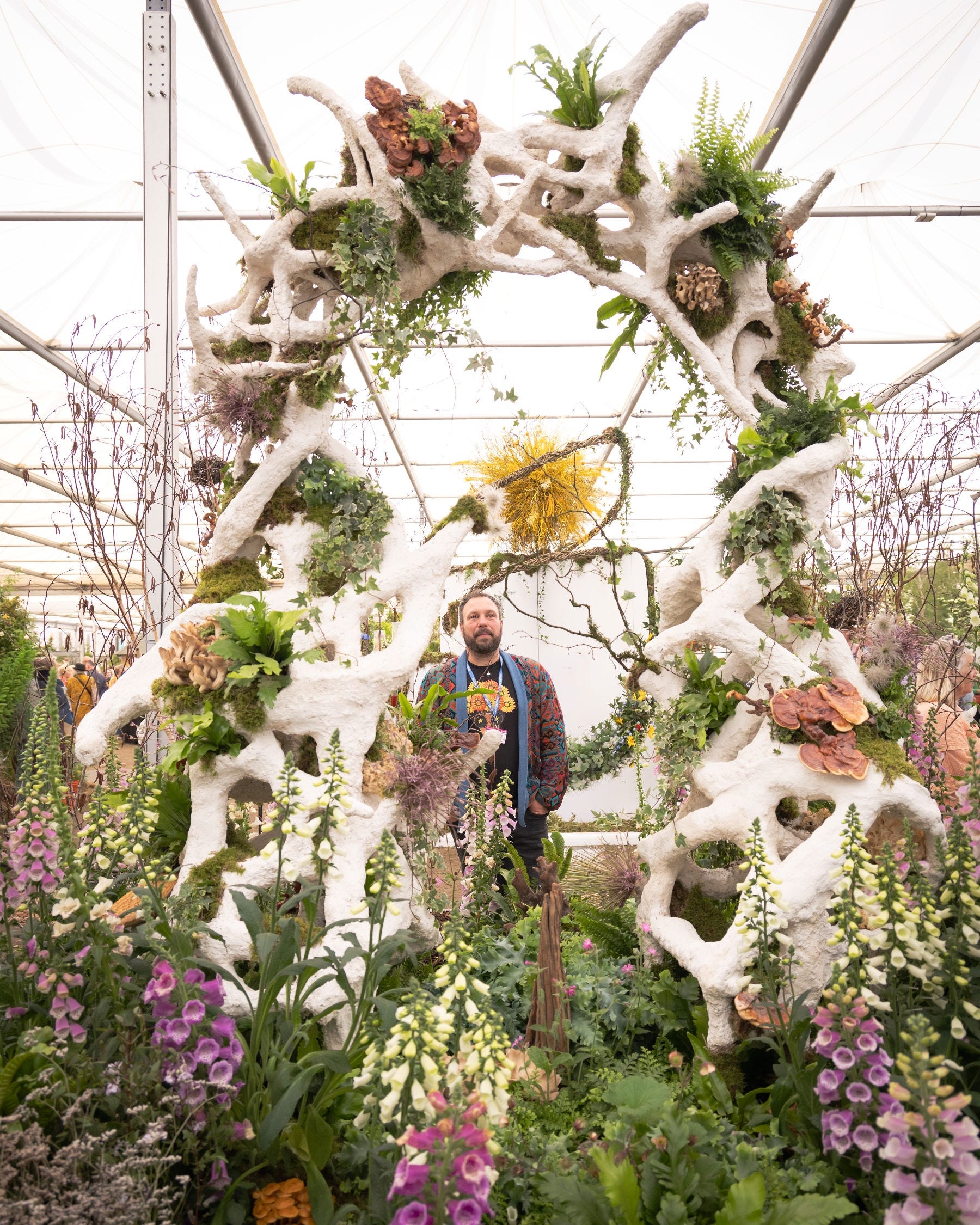
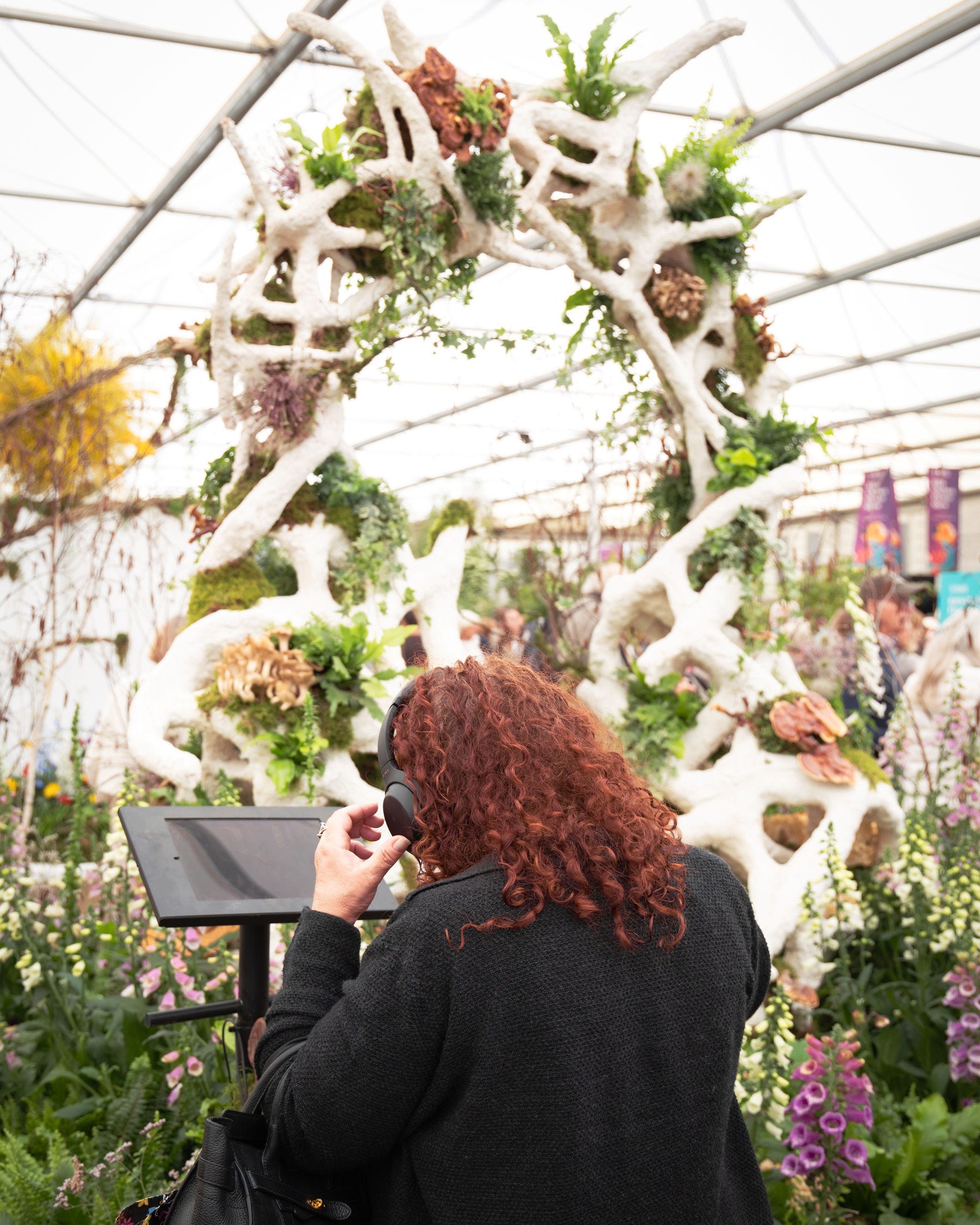
So, I take pleasure in the fact that this week, our daughter Gaia Eros has been co-presenting one of just three sustainability commissions at the 2026 RHS Chelsea Flower Show. Enmeshed: Positive Pathways, created with the botanical artist Dimitris (“Dimi”) Koutroumpas, is a sculpture built from reclaimed computer circuitry, lime-soaked hessian, native woodland flowers and living fungi. The BBC covered this, too.
On the same day I visited the Enmeshed stand, I also dropped into the British Museum to see their Hawai’i: A Kingdom Crossing Oceans exhibition in its final days. Given the title, I has assumed it would have a lot to say about navigation, but it didn’t. So I had to go on a deep dive of my own.
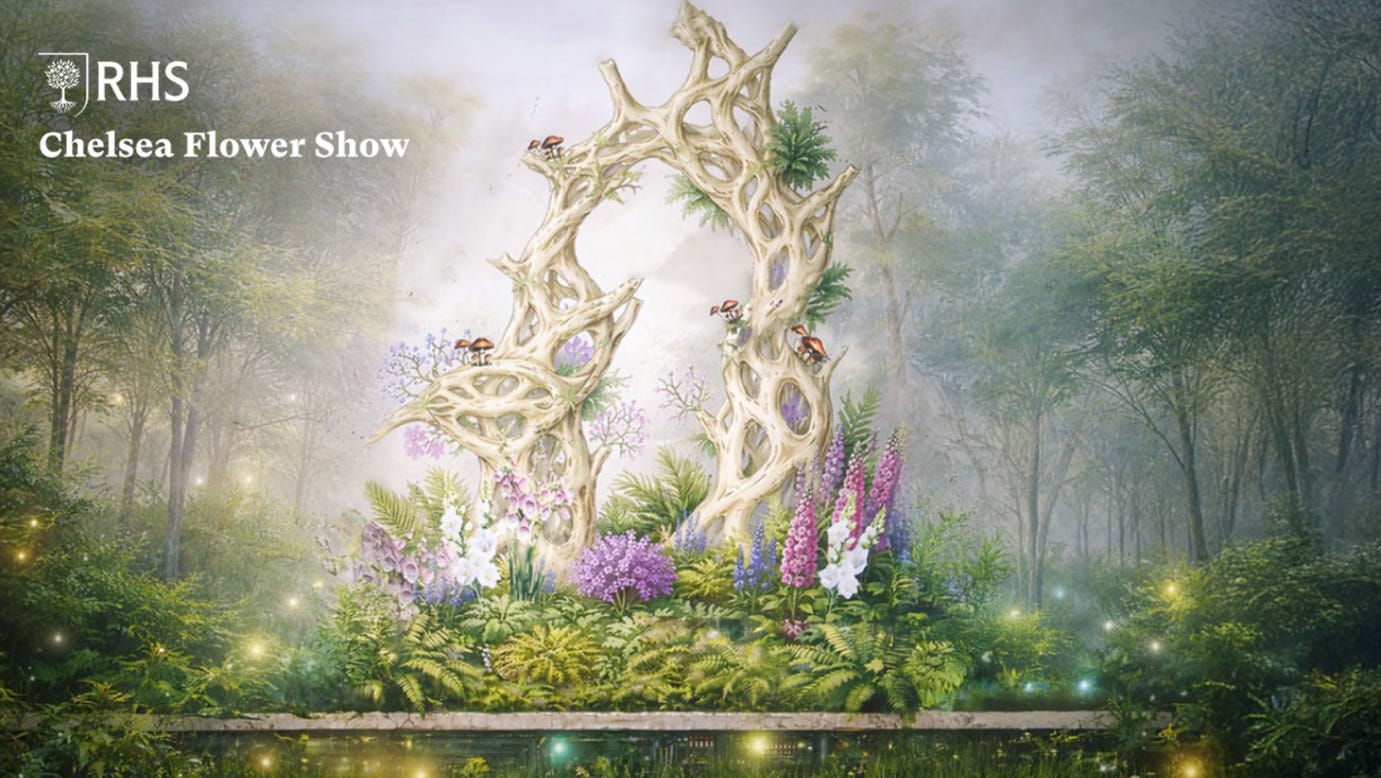
Like Micronesian master navigator Mau Piailug, we have to teach outsiders — and get much better at doing so. In that spirit, the Enmeshed exhibit draws an explicit parallel between two of the most powerful networks on the planet: the world wide web that humans built to exchange information, and the “wood wide web” — the underground mycelial filaments through which trees and fungi have been exchanging carbon, nitrogen and chemical signals for something like four hundred million years.
The deepest networks are the ones we did not invent. They run on a far older operating system than ours, and they are extraordinarily good at what they do. The emerging field of bioacoustics — the recording and decoding of the sounds a forest, a reef, an insect colony makes — is beginning to suggest that these networks talk far more than we noticed. Sheldrake, Simard, the whole new generation of fungal scientists are simply catching up with knowledge that older cultures, on both sides of the Pacific, never lost.
Among the suppliers to the Enmeshed project have been Jurassic Coast Mushrooms (a mushroom farm producing fresh, natural and organic gourmet and medicinal mushrooms), Phoam Labs (which helps florists switch from highly polluting traditional floral foam to sustainable “earth-to-earth” alternative) and the British Florist Association—whichbrings together everyone who shapes modern floristry.
It was also a delight to meet and talk to Alex Duncan, “The Composer in the Woods,” at the launch of Enmeshed. He was playing a live bioacoustics soundtrack generated by the organisms in the installation. At one point he had everyone present join hands in a circle—and played us the soundtrack of that, live. The moment brought the sense of connection to a different level.
And here is the join. Enmeshed sits on a truly hard fact: the digital revolution we have built on top of all this living infrastructure is generating a tidal wave of e-waste — the discarded phones, televisions, laptops and tablets in which the rare earths and precious metals of the planet are now buried in landfill.
The installation’s lead sponsor, Relove Technology, is a B Corp whose business is exactly this — recovering, refurbishing and reusing the technology the rest of us throw away, and doing so transparently enough to be audited against it. A small company, building a small network of return, beneath the noise of the larger one.
And, I was delighted to hear, a team using my age-old formulation of People, Planet and Profit to navigate realms where the necessary markets are only just emerging.
This, I think, is what the next phase in our collective wayfinding looks like in practice. Not a rejection of technology — Hōkūleʻa, after all, carries satellite phones for emergencies — but a re-enmeshing of technologies — old and new — with the older, slower, deeper systems we forgot we belonged to. Wayfinding by stars and swells. Forests that talk through fungi. A B Corp that treats your old phone as a part of the carbon and materials cycles rather something else to dump in the sk


Thanks, John. Have you come across the Cynefin company, in Wales? They are supporting folks to use broader means of sensemaking for navigating complex environments - and reapply these into business, NGOs, government, etc. A lot of it builds around your points around using innate means of moving forwards. It feels like sustainability practitioners could significantly benefit from honing these lost approaches. Perhaps that's the 'radical change' we're after - less about discovering the 'what', more about knowing a different 'how'...?